
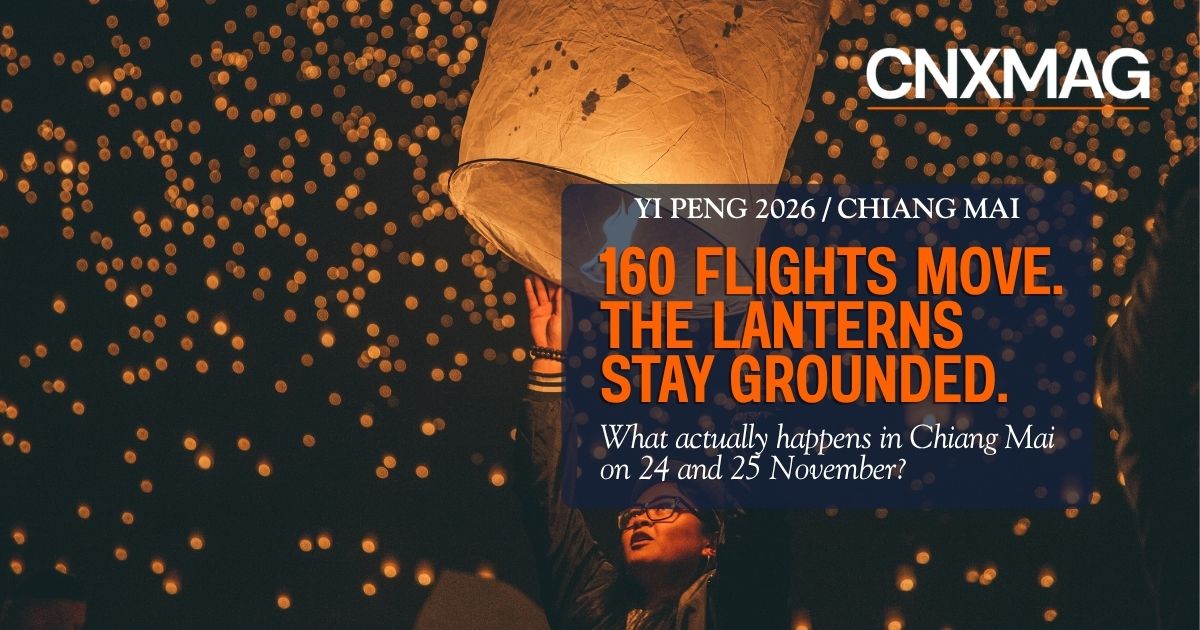

Updated 16 November 2026 with the official flight schedule announced by Chiang Mai International Airport on 3 November.
| Yi Peng 2026 at Chiang Mai airport | Confirmed figure |
|---|---|
| Festival nights | Tuesday 24 and Wednesday 25 November 2026 |
| Flights cancelled, 21 to 28 November | 108 |
| Flights rescheduled, 21 to 28 November | 80 |
| Extra flights added | 105 |
| No flights, evening | 19:00 to 01:00 on 24 and 25 November |
| Airlines asked to avoid, daytime | 10:00 to 12:00 on 24 November |
| Airport operating day | About 12 hours, down from about 20 |
| Daily flights across the period | About 210 on average, 232 at peak |
| Lanterns expected inside the safety zone | More than 200,000 |
| Check-in advice | Two hours before domestic flights, three hours before international |
In 2013, ground crews recovered 1,425 sky lanterns from the area around Chiang Mai International Airport. By 2017 the count had fallen to 108.
That reduction is the result of a decade of provincial regulation, airline scheduling, runway patrols and community permission requirements that almost none of the travel content about Yi Peng mentions. The festival is genuinely beautiful. It is also one of the most tightly managed aviation events in Southeast Asia.
Anyone flying, hosting guests or running a venue in November needs the operating picture rather than the photographs.
When is Yi Peng 2026 in Chiang Mai?
Yi Peng and Loy Krathong fall on 24 and 25 November 2026, with Loy Krathong proper on 24 November. The dates follow the full moon of the second month of the Lanna calendar and shift every year, which is why they moved from early November in 2025 to late November in 2026. The airport’s announcement on 3 November confirms both dates and adjusts flight schedules from 21 to 28 November.
Several tourism sites published incorrect dates for 2026 earlier in the year. The dates above were verified against the Thai lunar calendar in August and now match the airport’s own statement.
The two festivals are distinct and simultaneous. Yi Peng is the Lanna sky lantern tradition specific to the north. Loy Krathong is the nationwide festival of floating candlelit baskets on water. Chiang Mai runs both at once, which is the source of most of the confusion in English-language coverage. For the wider festival calendar, our guide to annual events and cultural celebrations in Chiang Mai covers how the year is structured.
Can you release sky lanterns in Chiang Mai?
Not inside Chiang Mai municipality. Sky lantern release within the city is prohibited under a provincial announcement applied alongside the Air Navigation Act. Legal mass releases take place only at licensed venues outside the city, typically around 30 kilometres out, and those events are ticketed. Free mass releases inside the old city do not exist and have not existed for years, despite what a large volume of travel content still claims.
This is the single most persistent piece of misinformation about the festival, and it produces a predictable pattern every November of visitors arriving at Tha Phae Gate expecting a photograph that is not available there.
What remains free and genuinely worth attending is the rest of it: temple ceremonies, the candlelit moat, the parades, the clay candles known as phang prateep, and Loy Krathong on the Ping River. Many repeat visitors prefer the free programme to the ticketed one.
The airport expects more than 200,000 sky lanterns and smoke lanterns inside its safety zone during the 2026 festival. Its statement repeats that releases are allowed only in the areas, on the dates and at the times set out in the provincial announcement, and that the red zones along the take-off and landing paths are strictly off-limits.
Where does the aviation safety zone around the airport extend?
The zone reaches 4.6 kilometres on each side of the runways and 18.5 kilometres beyond each end. Inside it, releasing lanterns, kites, balloons, makeshift rockets or drones is prohibited. The area covers 16 tambons of Mueang district, 11 of Hang Dong, five of Saraphi, five of Mae Rim, one of San Sai and one of San Pa Tong. That is most of the populated Chiang Mai basin, including the entire old city.
Airport director Wichit Kaewsaithiam set out the zone dimensions and the tambon list in Bangkok Post’s reporting on the provincial announcement, which remains the clearest published account of the boundary.
If you can see Doi Suthep from where you are standing, assume you are inside the zone.
How do you get permission for a legal lantern release?
Community leaders must apply to their district chief 30 days in advance. Once permission is granted, they must notify Chiang Mai airport or the aviation control centre a further 14 days ahead so that a notice can be issued to pilots. The full process therefore requires 44 days of lead time. No organiser can arrange a legal mass release on short notice, and any event advertising one has either filed months ago or is operating outside the framework.
The 44-day requirement is the practical reason licensed release venues are a small and stable group year to year rather than a market that new operators enter each season. For Yi Peng 2026 the filing deadline fell in early October, so no new legal release can be arranged now.
What time are lanterns allowed to be released?
Provincial announcements permit hot-air lantern release between 19:00 and 01:00 on the festival nights, with a separate daytime window for smoke lanterns. For 2026 the airport has matched those windows exactly: flights are suspended from 19:00 to 01:00 on 24 and 25 November, and airlines are asked to avoid 10:00 to 12:00 on 24 November. The governing instrument is a provincial announcement issued in 2020, applied alongside the Air Navigation Act.
Timing is enforced rather than advisory, and airport authorities remind organisers each year that time restrictions are checked. Runway patrols have increased to 10 times daily across the festival period in previous years, and for 2026 the airport has confirmed additional airside inspections for lanterns and debris and formal notices to pilots and aircrew.
The release window is the reason the airport’s evening schedule disappears. The two are designed against each other, and neither can move independently.
Are flights cancelled during Yi Peng?
Yes. For 2026, airlines have cancelled 108 flights and rescheduled 80 at Chiang Mai airport between 21 and 28 November, a total of 188, and have added 105 extra services. The figures reflect schedules as of 30 October and were announced by airport general manager Group Captain Sakan Udol. Airlines notify passengers directly, which means accommodation providers frequently learn about a change after the guest does.
The scale has been consistent for a decade, with 2022 the exception in a year of reduced air traffic:
| Festival year | Flights affected | Breakdown |
|---|---|---|
| 2015 | 135 | 84 cancelled, 51 rescheduled |
| 2018 | 148 | 60 cancelled, 88 rescheduled |
| 2022 | 69 | 55 cancelled, 14 rescheduled, six extra added |
| 2023 | 160 | 101 cancelled, 59 rescheduled |
| 2024 | 170 | 74 cancelled, 96 rescheduled |
| 2025 | 161 | 65 cancelled, 96 rescheduled, 44 extra added |
| 2026 | 188 | 108 cancelled, 80 rescheduled, 105 extra added |
The 2026 total is the highest in this table, and so is the number of cancellations. The 105 extra flights are more than double the 44 added in 2025, which gives passengers on cancelled evening services more daytime alternatives. The 2026 figures come from The Nation’s report of the airport’s statement. Each year’s count was announced on a different date ahead of the festival, and airlines continue to adjust schedules afterwards.
In 2023 the changes amounted to 47 per cent of normal flights, a figure that comes from Bangkok Post’s coverage of the 2023 adjustments. Close to half the schedule moves. Live status for any individual flight is published by the airport operator at Chiang Mai International Airport’s official AOT site.
What time does Chiang Mai airport stop flying during the festival?
No flights operate between 19:00 and 01:00 on the nights of 24 and 25 November 2026, and airlines are asked to avoid 10:00 to 12:00 on 24 November. The airport’s operating day falls from about 20 hours to about 12. The airport does not close, and daytime operations run normally. For anyone booked on an evening arrival, the practical effect is identical to a closure.
The pattern repeats the previous year. Airport general manager Karun Thanakuljirapat confirmed a 19:00 cutoff for the 2025 festival, with all airlines rescheduling to finish before that time, and Khaosod English reported the 2025 arrangements in detail, including the reasoning behind the cutoff.
How busy is Chiang Mai airport during the lantern festival?
The airport expects about 210 flights a day on average between 21 and 28 November 2026, with a peak of 232, roughly 10 per cent above a normal day. That traffic moves through an operating day shortened by about eight hours on the festival dates. The airport advises passengers to arrive two hours before domestic flights and three hours before international flights.
The airport has allocated check-in counters by flight, added passenger and baggage screening points, and asked passengers to use online check-in, self-service kiosks and self bag drop. Arrivals are served by about 1,280 daily trips across airport limousines, metered taxis, the shuttle bus and the RTC city bus, about 2,500 Grab vehicles and nine car hire operators. For comparison, Nation Thailand reported the 2025 passenger projections of more than 32,000 travellers daily, roughly 17 per cent above normal levels.
Anyone who has queued at the domestic terminal during festival week has experienced more people inside a day that is several hours shorter.
Has the lantern safety campaign actually worked?
Yes, by roughly 92 per cent. Ground crews recovered 1,425 lanterns from the airport area in 2013. By 2017 the figure had fallen to 108. Airport flight officer Thananrat Prasertsri attributed the reduction to sustained safety awareness campaigns rather than to any decline in the festival itself. The regulation is the reason Yi Peng still runs at full scale rather than having been curtailed on safety grounds.
The figures were reported by Khaosod English in its coverage of the airport’s festival preparations.
This is worth stating plainly in a conversation that usually pits culture against safety as though the two had not already been reconciled here, over a decade, with results.
What should hotels and operators do now?
Three actions, all of them this week. Check every booking arriving or departing between 21 and 28 November against the airline’s current schedule, and every booking on 24 or 25 November against the 19:00 to 01:00 suspension. Widen airport transfer windows, since daytime operations are heavier and road access is congested. Brief guests on lantern legality before they ask, naming the safety zone and pointing to licensed venues.
A guest who held a 21:00 arrival into Chiang Mai on either festival night is holding a flight that has already moved. Airlines contact the passenger, not the property, and a rebooked arrival that nobody at the hotel knows about becomes a missed transfer and a poor review.
The visitor who books a ticketed release having understood why it is ticketed has a better night than the one who turns up at the moat expecting something that has not happened there since before the pandemic. Setting that expectation in a pre-arrival email costs nothing and prevents the single most common Yi Peng complaint.
Official guidance for the festival period is published by the Tourism Authority of Thailand newsroom, and passengers can confirm any individual flight with their airline.
Change note, 16 November 2026: added the official 2026 flight figures, suspension windows, traffic forecast and passenger advice from the airport’s 3 November statement. Added 2024 to the year table. Updated the advice for hotels and operators.
CNX Mag covers city and culture across Chiang Mai. Commercial and infrastructure reporting runs at Chiang Mai Business Network. Verified hotels, venues and tour operators are listed on Golden Pages.