
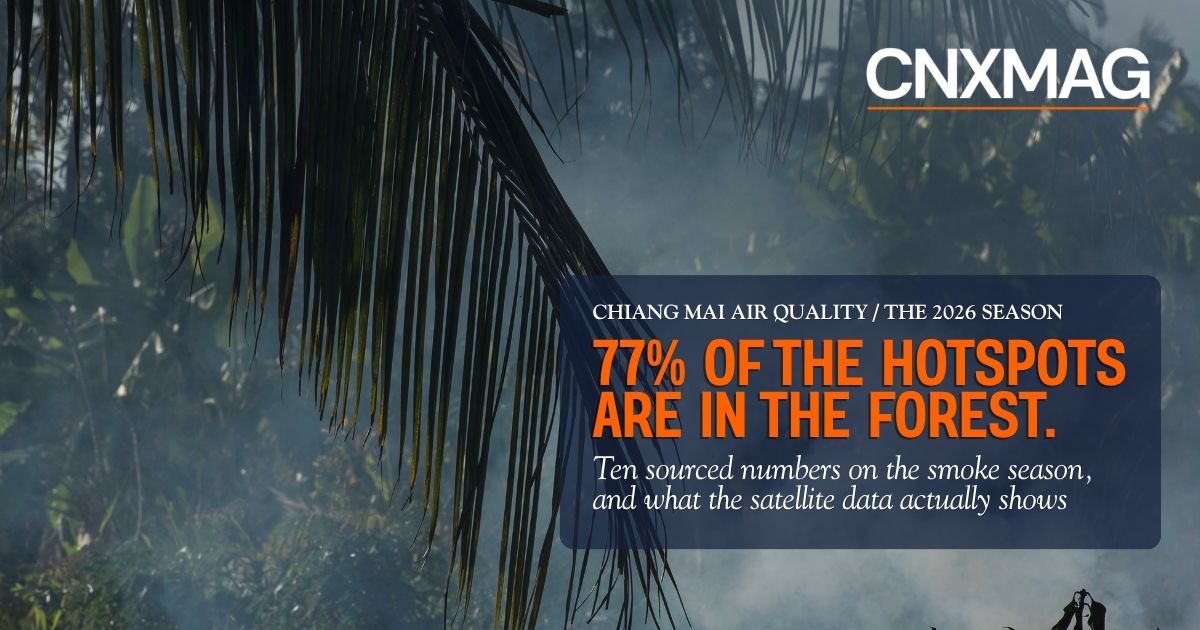

Chiang Mai’s annual average PM2.5 runs at 5.2 times the WHO guideline. Roughly 77 per cent of the hotspots behind it burn in forest rather than farmland, and on a bad day most of the regional smoke originates outside Thailand entirely.
On 4 April 2026, visibility at Nakornping Hospital in Mae Rim dropped far enough that the Straits Times ran it as a news event in its own right. A hospital being hard to see is not a statistic anyone plans to collect.
Chiang Mai residents live this season by feel. The sky changes colour in late February, the throat goes first, and by March the mountains have disappeared behind the murk.
What follows is the same season expressed in figures, drawn from air quality monitors, satellite fire detection, hospital reporting and the parliamentary record. Every number is sourced, and where a figure comes from a secondary outlet rather than the originating agency, that is stated.
How bad is Chiang Mai’s air quality on average?
Chiang Mai’s mean PM2.5 concentration across 2024 was 26.4 micrograms per cubic metre, which is 5.2 times the World Health Organization annual guideline of 5 micrograms. IQAir classifies that as a moderate annual AQI of 81. The annual average is the honest measure because it captures the whole year rather than the crisis, and it shows a city running at five times the guideline even after eight clean months are averaged in.
Live readings are published on the IQAir Chiang Mai monitoring page and on the independent AQICN station feed.
How bad does it get at the peak?
District readings passed 300 micrograms per cubic metre on 1 April 2026. Held against the city’s own annual mean of 26.4, the worst district readings ran roughly 11 times higher and 60 times the WHO guideline. Those peaks concentrate in a six to eight week window between late February and mid April. On 2 April, Nation Thailand recorded an AQI of 231, and the city sat inside the global top three on several separate days.
The five week pattern rather than any single peak is what drew coverage from the BBC and Channel NewsAsia, and it is what prompted the response described further down this page.
What actually causes the smoke in northern Thailand?
Forest fire accounts for most of it. GISTDA satellite analysis found that 77 per cent of Thai hotspots occur in forests, 18 per cent in farming zones and 5 per cent in urban areas. The majority sit inside conservation forest and national forest reserve at high elevation, terrain that is difficult to access on foot and complex to work in once a fire has taken hold. The widely repeated explanation that crop stubble burning drives the season understates the forest share considerably.
The distinction matters because the two fire types demand different responses. Crop residue burning happens on accessible farmland reachable by road. Fire in a mountain forest reserve requires aerial capability, specialist crews and days of sustained work on ground where vehicles cannot go.
The breakdown appeared in Bangkok Post’s special report on Thai air pollution, citing GISTDA satellite thermal imaging. Almost every English-language guide to the burning season leads with farmers burning fields, which is a reasonable assumption and not what the satellite data shows.
How much of the smoke comes from outside Thailand?
Most of it, on a bad day. On one March 2026 morning, GISTDA recorded 2,302 hotspots across the whole of Thailand. Myanmar recorded 8,804 on the same day and Laos 4,189. Of those three countries, Thailand accounted for roughly 15 per cent of the total. Northern provinces sit downwind of both borders, which means Chiang Mai air quality on any given day reflects fire activity across a region far wider than Thailand.
The regional figures were reported by Chiang Rai Times in its coverage of provincial burning controls.
This is the single most useful figure for understanding why the problem persists despite sustained domestic effort. Thai agencies can control Thai hotspots, and Thai hotspots are the smaller share. That arithmetic is precisely why the Clean Air Act carries transboundary provisions and why Thailand has pursued regional cooperation through the ASEAN haze framework.
What is Thailand’s PM2.5 standard?
Thailand’s 24-hour PM2.5 standard is 37.5 micrograms per cubic metre, tightened from a previous limit of 50. The reduction moved the national standard closer to the WHO 24-hour guideline of 15 micrograms and made Thai reporting stricter against its own measurements. The WHO annual guideline is 5 micrograms. Countries across the region sit at varying distances from those guidelines, and Thailand tightened its own threshold rather than waiting to be pushed.
A tighter standard means more days officially recorded as exceeding the limit, which is a choice in favour of transparency over favourable statistics.
How many people seek treatment during burning season?
Patient numbers roughly doubled at facilities across Chiang Mai province during the peak period in late March and early April 2026. During the 2023 season, Maharaj Nakorn Hospital recorded more than 12,000 patients seeking treatment for respiratory issues between January and March, covering asthma, upper respiratory infection, conjunctivitis and emphysema. Consolidated 2026 figures have not yet been published in comparable form.
Nation Thailand reported the doubling without publishing a baseline, so the figure indicates direction rather than magnitude.
Provincial public health offices across the north run emergency medical and public health operations meetings under the PHEOC system through the season, and the NGO Chiang Mai Breathe Council has worked alongside them to expand the number of clean air rooms available across the province.
When does Chiang Mai’s burning season start and end?
Air quality deteriorates from late January, peaks through March, and generally clears by mid to late April. Chiang Mai province prohibited all open burning from 1 February to 31 May 2026, a four month window covering the full risk period. Hotspot counts began falling in early April while air quality had not yet recovered, because particulate matter already held in a mountain basin disperses on a slower cycle than the fires that produced it.
That lag between falling hotspots and improving air was captured by the Bangkok Post on 7 April, and it is the reason enforcement success and visible improvement arrive several days apart.
For anyone planning around the northern calendar, the season overlaps the Flower Festival in February and Songkran in April. Our guide to annual events and cultural celebrations in Chiang Mai sets out how the year is structured.
How did authorities respond in 2026?
Quickly and across several agencies at once. Thailand’s Ministry of Interior declared Chiang Mai, Lamphun and Phayao emergency disaster zones on 4 April, releasing emergency funds to provincial governors within days of readings peaking. Separate declarations covered Pai and Mae Sariang. On 8 April the Third Army Area commander chaired operational planning in Mae Rim and joined an aerial firefighting mission over the province.
The Bangkok Post reported the declarations and their funding effect.
Alongside the emergency response, GISTDA issues a weekly wildfire risk forecast built from satellite imagery and geospatial modelling, naming the provinces at highest risk for the week ahead. For the last week of April it named Chiang Mai, Tak, Mae Hong Son, Lampang and Nan, and forwarded the detailed analysis to operational agencies so fuel management could be planned in advance rather than in response.
For businesses in the declared districts, the designation also establishes an official record of the period, which carries weight for insurance purposes and for any future claim of force majeure.
What stage has Thailand’s Clean Air Act reached?
Parliament voted 611 to three with one abstention on 15 May 2026 to advance the Clean Air Act, sending it to the Senate for scrutiny before submission to the prime minister and the king. The near-unanimous margin reflects cross-party agreement on a bill that establishes clean air as a protected public right, creates a Clean Air Fund, addresses transboundary pollution and gives legal standing to community sensor networks.
AFP reported the vote count, carried by The Star. The clearest plain-language account of what the act contains is HaRDstories’ explainer.
The legislation began as citizen-initiated law, first proposed by a coalition of civil society groups and later consolidated from seven separate drafts into one. Cabinet reaffirmed it in May among 31 draft laws set to continue through the legislative process. A bill assembled from seven competing versions and passed 611 to three represents an unusual degree of consensus in any parliament.
Where should you check Chiang Mai air quality?
Air4Thai is the official portal, operated by Thailand’s Pollution Control Department, which has collected air quality data since 1996 and provides the historical baseline every other source compares against. It reports raw PM2.5 in micrograms per cubic metre rather than the US EPA AQI number, which is why its figures look lower than IQAir’s for the same hour. IQAir and AQICN add denser sensor coverage and AQI conversion.
Check Air4Thai from the Pollution Control Department for the official reading and IQAir for the internationally comparable index. The two measure the same air on different scales, and a discrepancy between them is a units difference rather than a disagreement.
Thirty years of continuous PCD monitoring is the reason northern Thailand has usable historical data at all. Most of the region does not.
The number nobody has
The World Health Organization attributes more than 32,000 premature deaths in Thailand annually to air pollution across every source nationwide. No published dataset isolates the effect of one northern season.
The commercial figure is missing too. Punlop Saejew, vice president of the Chiang Mai Chamber of Commerce, told the Bangkok Post that smog had affected bookings ahead of Songkran. Beyond that observation, hotel cancellation rates, restaurant covers, tour bookings and school closure days across February to April sit inside individual businesses and have never been aggregated for the province.
That gap is one the business community is better placed to close than any agency. Government monitoring already delivers PM2.5 to one decimal place, hour by hour, from stations running since 1996. What it cannot see is a booking system, and no ministry has access to one.
An aggregated commercial figure for the season, contributed voluntarily and anonymised, would give the Chamber, the province and the operators themselves something none of them currently holds. The health case for continued investment is already well made. The economic case is waiting on data that only Chiang Mai businesses can supply.
This article covers publicly reported air quality data. Anyone with a respiratory condition should seek advice from a doctor rather than from an index.
CNX Mag covers city and culture across Chiang Mai. Commercial and policy reporting runs at Chiang Mai Business Network. Verified local business listings are published on Golden Pages.