
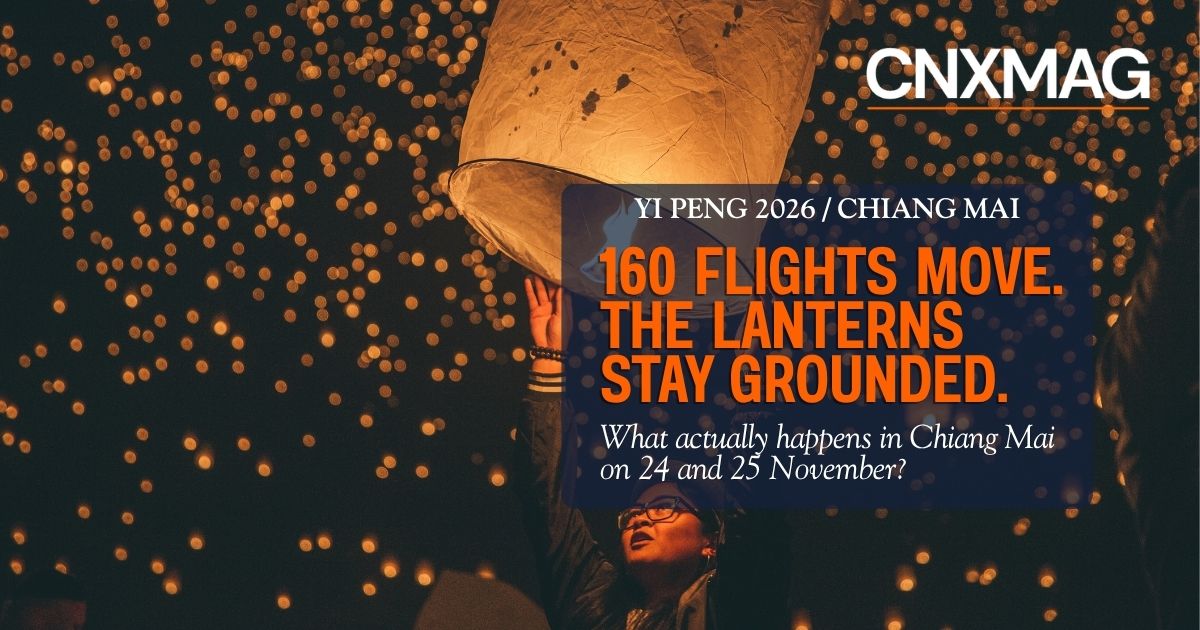

Yi Peng falls on 24 and 25 November 2026. In a typical year Chiang Mai airport cancels or reschedules around 160 flights, evening operations stop at 19:00, and releasing a sky lantern in most of the Chiang Mai basin is illegal.
In 2013, ground crews recovered 1,425 sky lanterns from the area around Chiang Mai International Airport. By 2017 the count had fallen to 108.
That reduction is the result of a decade of provincial regulation, airline scheduling, runway patrols and community permission requirements that almost none of the travel content about Yi Peng mentions. The festival is genuinely beautiful. It is also one of the most tightly managed aviation events in Southeast Asia.
Anyone flying, hosting guests or running a venue in November needs the operating picture rather than the photographs.
When is Yi Peng 2026 in Chiang Mai?
Yi Peng and Loy Krathong fall on 24 and 25 November 2026, with Loy Krathong proper on 24 November. The dates follow the full moon of the second month of the Lanna calendar and shift every year, which is why they moved from early November in 2025 to late November in 2026. The official city programme of free public events is usually confirmed in late October.
Several tourism sites currently publish incorrect dates for 2026. The dates above are verified against the Thai lunar calendar rather than taken from event listings.
The two festivals are distinct and simultaneous. Yi Peng is the Lanna sky lantern tradition specific to the north. Loy Krathong is the nationwide festival of floating candlelit baskets on water. Chiang Mai runs both at once, which is the source of most of the confusion in English-language coverage. For the wider festival calendar, our guide to annual events and cultural celebrations in Chiang Mai covers how the year is structured.
Can you release sky lanterns in Chiang Mai?
Not inside Chiang Mai municipality. Sky lantern release within the city is prohibited under a provincial announcement applied alongside the Air Navigation Act. Legal mass releases take place only at licensed venues outside the city, typically around 30 kilometres out, and those events are ticketed. Free mass releases inside the old city do not exist and have not existed for years, despite what a large volume of travel content still claims.
This is the single most persistent piece of misinformation about the festival, and it produces a predictable pattern every November of visitors arriving at Tha Phae Gate expecting a photograph that is not available there.
What remains free and genuinely worth attending is the rest of it: temple ceremonies, the candlelit moat, the parades, the clay candles known as phang prateep, and Loy Krathong on the Ping River. Many repeat visitors prefer the free programme to the ticketed one.
Where does the aviation safety zone around the airport extend?
The zone reaches 4.6 kilometres on each side of the runways and 18.5 kilometres beyond each end. Inside it, releasing lanterns, kites, balloons, makeshift rockets or drones is prohibited. The area covers 16 tambons of Mueang district, 11 of Hang Dong, five of Saraphi, five of Mae Rim, one of San Sai and one of San Pa Tong. That is most of the populated Chiang Mai basin, including the entire old city.
Airport director Wichit Kaewsaithiam set out the zone dimensions and the tambon list in Bangkok Post’s reporting on the provincial announcement, which remains the clearest published account of the boundary.
If you can see Doi Suthep from where you are standing, assume you are inside the zone.
How do you get permission for a legal lantern release?
Community leaders must apply to their district chief 30 days in advance. Once permission is granted, they must notify Chiang Mai airport or the aviation control centre a further 14 days ahead so that a notice can be issued to pilots. The full process therefore requires 44 days of lead time. No organiser can arrange a legal mass release on short notice, and any event advertising one has either filed months ago or is operating outside the framework.
The 44-day requirement is the practical reason licensed release venues are a small and stable group year to year rather than a market that new operators enter each season.
What time are lanterns allowed to be released?
Provincial announcements have historically permitted hot-air lantern release between 19:00 and 01:00, with separate daytime windows for smoke lanterns. The governing instrument is a provincial announcement issued in 2020, applied alongside the Air Navigation Act. Timing is enforced rather than advisory, and airport authorities remind organisers each year that time restrictions are checked. Runway patrols increase to 10 times daily across the festival period.
The release window is the reason the airport’s evening schedule disappears. The two are designed against each other, and neither can move independently.
Are flights cancelled during Yi Peng?
Yes, in substantial numbers every year. Chiang Mai airport typically cancels or reschedules between 130 and 161 flights across the festival period. In 2023 the changes covered 101 cancellations and 59 reschedulings, amounting to 47 per cent of normal flights. In 2025 the figure was 161 flights, comprising 65 cancellations and 96 schedule changes. Airlines notify passengers directly, which means accommodation providers frequently learn about a change after the guest does.
The scale has been consistent for a decade:
| Festival year | Flights affected | Breakdown |
|---|---|---|
| 2015 | 135 | 84 cancelled, 51 rescheduled |
| 2018 | 148 | 60 cancelled, 88 rescheduled |
| 2022 | 69 | 55 cancelled, 14 rescheduled, six extra added |
| 2023 | 160 | 101 cancelled, 59 rescheduled |
| 2025 | 161 | 65 cancelled, 96 rescheduled |
The 47 per cent figure comes from Bangkok Post’s coverage of the 2023 adjustments. Close to half the schedule moves. Live status for any individual flight is published by the airport operator at Chiang Mai International Airport’s official AOT site.
What time does Chiang Mai airport stop flying during the festival?
All flight operations end by 19:00 on the main festival nights. The airport does not close, and daytime operations run normally, but nothing departs or lands after early evening. Airport general manager Karun Thanakuljirapat confirmed the 19:00 cutoff for the 2025 festival, with all airlines rescheduling to finish before that time. For anyone booked on an evening arrival, the practical effect is identical to a closure.
Khaosod English reported the 2025 arrangements in detail, including the reasoning behind the cutoff.
How busy is Chiang Mai airport during the lantern festival?
Passenger volume exceeds 32,000 travellers daily, roughly 17 per cent above normal levels. That higher volume moves through a shortened operating day, since the evening schedule compresses into daylight hours. The airport responds with additional staff, self-service check-in kiosks, common-use bag drop and biometric screening. The compression is the reason queue times during festival week bear no relationship to a normal November morning.
Nation Thailand reported the 2025 passenger projections alongside the airport’s mitigation measures.
Anyone who has queued at the domestic terminal during festival week has experienced 17 per cent more people inside a day that is several hours shorter.
Has the lantern safety campaign actually worked?
Yes, by roughly 92 per cent. Ground crews recovered 1,425 lanterns from the airport area in 2013. By 2017 the figure had fallen to 108. Airport flight officer Thananrat Prasertsri attributed the reduction to sustained safety awareness campaigns rather than to any decline in the festival itself. The regulation is the reason Yi Peng still runs at full scale rather than having been curtailed on safety grounds.
The figures were reported by Khaosod English in its coverage of the airport’s festival preparations.
This is worth stating plainly in a conversation that usually pits culture against safety as though the two had not already been reconciled here, over a decade, with results.
What should hotels and operators do now?
Three actions, all of them before October. Check every inbound booking dated 24 or 25 November against the 19:00 cutoff. Widen airport transfer windows, since daytime operations are heavier and road access is congested. Brief guests on lantern legality before they ask, naming the safety zone and pointing to licensed venues.
A guest holding a 21:00 arrival into Chiang Mai on either festival night is holding a flight that will move. Airlines contact the passenger, not the property, and a rebooked arrival that nobody at the hotel knows about becomes a missed transfer and a poor review.
The visitor who books a ticketed release having understood why it is ticketed has a better night than the one who turns up at the moat expecting something that has not happened there since before the pandemic. Setting that expectation in a pre-arrival email costs nothing and prevents the single most common Yi Peng complaint.
Official guidance for the festival period is published by the Tourism Authority of Thailand newsroom, and the provincial programme of free events appears from late October.
CNX Mag covers city and culture across Chiang Mai. Commercial and infrastructure reporting runs at Chiang Mai Business Network. Verified hotels, venues and tour operators are listed on Golden Pages.